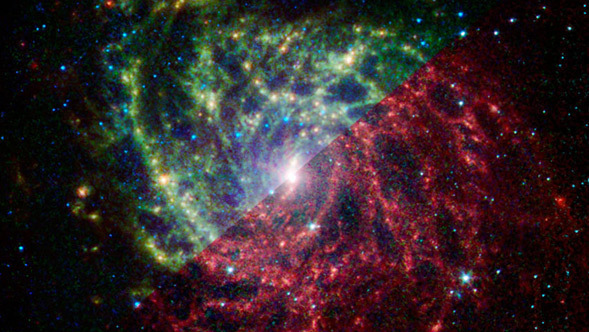
Those aren't insects trapped in a spider's web -- they're stars in our own Milky Way galaxy, lying between us and another spiral galaxy called IC 342. NASA's Spitzer Space Telescope captured this picture in infrared light, revealing the galaxy's bright patterns of dust.
 Credit: NASA's Spitzer Space Telescope
At a distance of about 10 million light-years from Earth, IC 342 is relatively close by galaxy standards. However, our vantage point places it directly behind the disk of our own Milky Way. The intervening dust makes it difficult to see in visible light, but infrared light penetrates this veil easily. While stars in our own galaxy appear as blue/white dots, the blue haze is from IC 342's collective starlight. Red shows the dust structures, which contain clumps of new stars.
The center of the galaxy, where one might look for a spider, is actually home to an enormous burst of star formation. To either side of the center, a small bar of dust and gas is helping to fuel the new stars.
Looking like a spiders web swirled into a spiral, the galaxy IC 342 presents its delicate pattern of dust in this image from NASAs Spitzer Space Telescope. Seen in infrared light, the faint starlight gives way to the glowing bright patterns of dust found throughout the galaxys disk. The intervening dust makes it difficult to see in visible light, but infrared light penetrates this veil easily. It belongs to the same group as its even more obscured galaxy neighbor, Maffei 2.
IC 342 is nearly face-on to our view giving a clear, top-down view of the structure of its disk. It has a low surface brightness compared to other spirals, indicating a lower density of stars (seen here in blue). Its dust structures show up much more vividly (yellow-green).
 Credit: NASA's Spitzer Space Telescope
New stars are forming in the disk at a healthy clip. Glowing like gems trapped in the web, regions of heavy star formation appear as yellow-red dots due to the glow of warm dust. The very center glows especially brightly in the infrared, highlighting an enormous burst of star formation occurring in this tiny region. To either side of the center, a small bar of dust and gas is helping to fuel this central star formation.
 Credit: NASA's Spitzer Space Telescope
Data from Spitzers infrared array camera (IRAC) are shown in blue (3.6 and 4.5 microns) and green (5.8 and 8.0 microns) while the multiband imaging photometer (MIPS) observation is red (24 microns).
NASA's Jet Propulsion Laboratory, Pasadena, Calif., manages the Spitzer Space Telescope mission for NASA's Science Mission Directorate, Washington. Science operations are conducted at the Spitzer Science Center at the California Institute of Technology in Pasadena. Caltech manages JPL for NASA.
Source: NASA
Spiral galaxy called IC 342
At a distance of about 10 million light-years from Earth, IC 342 is relatively close by galaxy standards. However, our vantage point places it directly behind the disk of our own Milky Way. The intervening dust makes it difficult to see in visible light, but infrared light penetrates this veil easily. While stars in our own galaxy appear as blue/white dots, the blue haze is from IC 342's collective starlight. Red shows the dust structures, which contain clumps of new stars.
The center of the galaxy, where one might look for a spider, is actually home to an enormous burst of star formation. To either side of the center, a small bar of dust and gas is helping to fuel the new stars.
Looking like a spiders web swirled into a spiral, the galaxy IC 342 presents its delicate pattern of dust in this image from NASAs Spitzer Space Telescope. Seen in infrared light, the faint starlight gives way to the glowing bright patterns of dust found throughout the galaxys disk. The intervening dust makes it difficult to see in visible light, but infrared light penetrates this veil easily. It belongs to the same group as its even more obscured galaxy neighbor, Maffei 2.
IC 342 is nearly face-on to our view giving a clear, top-down view of the structure of its disk. It has a low surface brightness compared to other spirals, indicating a lower density of stars (seen here in blue). Its dust structures show up much more vividly (yellow-green).
New stars are forming in the disk at a healthy clip. Glowing like gems trapped in the web, regions of heavy star formation appear as yellow-red dots due to the glow of warm dust. The very center glows especially brightly in the infrared, highlighting an enormous burst of star formation occurring in this tiny region. To either side of the center, a small bar of dust and gas is helping to fuel this central star formation.
Data from Spitzers infrared array camera (IRAC) are shown in blue (3.6 and 4.5 microns) and green (5.8 and 8.0 microns) while the multiband imaging photometer (MIPS) observation is red (24 microns).
NASA's Jet Propulsion Laboratory, Pasadena, Calif., manages the Spitzer Space Telescope mission for NASA's Science Mission Directorate, Washington. Science operations are conducted at the Spitzer Science Center at the California Institute of Technology in Pasadena. Caltech manages JPL for NASA.
Source: NASA

0 comments:
Post a Comment