The Large Magellanic Cloud is a small neighbouring galaxy to the Milky Way. It contains many regions where clouds of gas and dust are forming new stars. One such region, surrounding the star cluster NGC 1929, is shown in close-up in this new image from ESO's Very Large Telescope. This nebula is officially known as LHA 120–N 44, or just N 44 for short.
ESO’s Very Large Telescope has been used to obtain this view of the nebula LHA 120-N 44 surrounding the star cluster NGC 1929. Lying within the Large Magellanic Cloud, a satellite galaxy of our own Milky Way, this region of star formation features a colossal superbubble of material expanding outwards due to the influence of the cluster of young stars at its heart that sculpts the interstellar landscape and drives forward the nebula’s evolution.

Hot young stars in NGC 1929 are emitting intense ultraviolet light and causing the gas to glow. This effect highlights the aptly-named superbubble, a vast shell of material around 325 by 250 light-years across. For comparison, the nearest star to our Sun is just over four light-years distant.
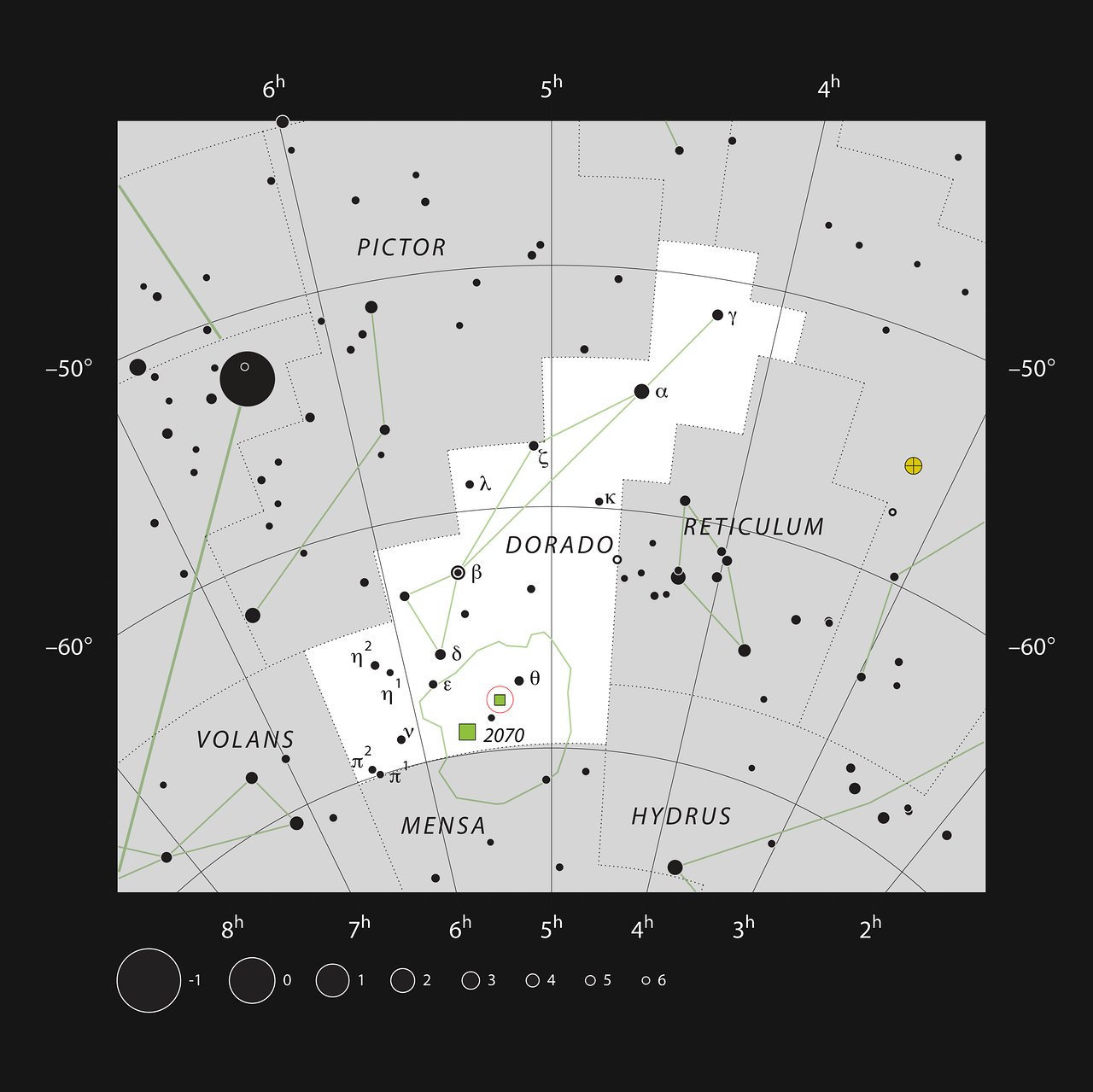
This chart shows the location of the star formation region and superbubble LHA 120–N 44 around the star cluster NGC 1929 within the constellation of Dorado (The Dolphin Fish). This map shows most of the stars visible to the unaided eye under good conditions, and the nebula is marked as a green square within a red circle. Through a moderate-sized amateur telescope this object can be seen as a faint glow.
The N 44 superbubble has been produced by the combination of two processes. Firstly, stellar winds — streams of charged particles from the very hot and massive stars in the central cluster — cleared out the central region. Then massive cluster stars exploded as supernovae creating shockwaves and pushing the gas out further to form the glowing bubble.
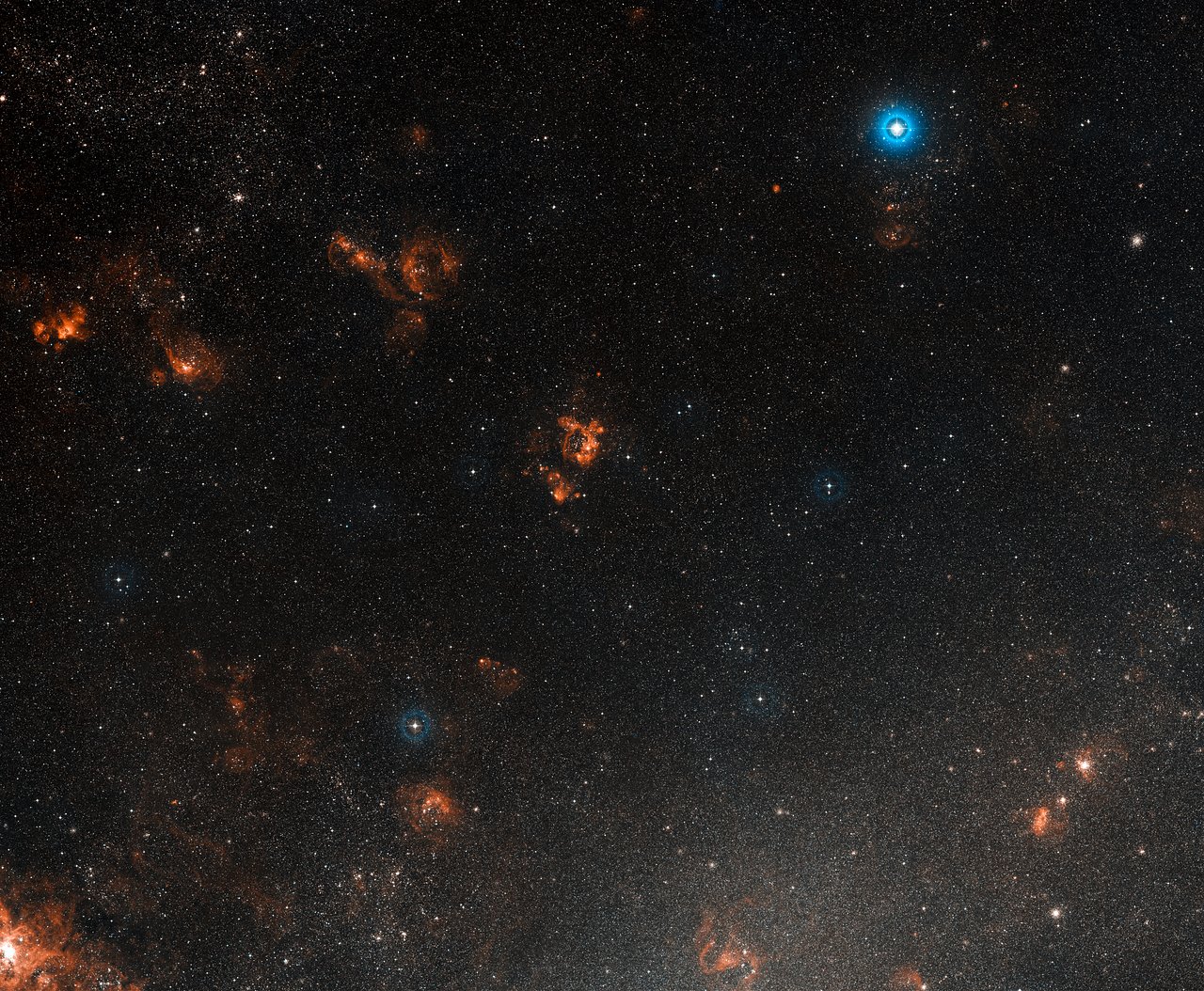
This visible-light wide-field image of the area around the star-forming region LHA 120–N 44 surrounding the cluster NGC 1929, was created from photographs taken through red and blue filters and forming part of the Digitized Sky Survey 2. The superbubble appears close to the centre and several other star formation regions are visible in the surrounding sky. The field of view is approximately three degrees across.
Although the superbubble is shaped by destructive forces, new stars are forming around the edges where the gas is being compressed. Like recycling on a cosmic scale, this next generation of stars will breathe fresh life into NGC 1929.
The image was created by ESO from observational data identified by Manu Mejias, from Argentina [1], who participated in ESO's Hidden Treasures 2010 astrophotography competition [2]. The competition was organised by ESO in October–November 2010, for everyone who enjoys making beautiful images of the night sky using astronomical data obtained using professional telescopes.
This sequence starts with a wide-field view of the southern Milky Way and the two Magellanic Clouds. As we zoom in, we can see many of the clusters and star formation regions within the Large Magellanic Cloud. In the final sequence we close in on one region, around the star cluster NGC 1929, which features a huge superbubble. This detailed view was captured by the FORS instrument on ESO’s Very Large Telescope at the Paranal Observatory in Chile. http://www.eso.org/public/videos/eso1125a/
Credit: ESO/Digitized Sky Survey 2/R. Gendler/S. Brunier. Music: John Dyson (from the album Moonwind)
Contacts and sources:
Douglas Pierce-Price
ESO
ESO's Hidden Treasures 2010 competition gave amateur astronomers the opportunity to search through ESO's vast archives of astronomical data, hoping to find a well-hidden gem that needed polishing by the entrants. To find out more about Hidden Treasures, visit http://www.eso.org/public/outreach/hiddentreasures/.

0 comments:
Post a Comment