At the 2012 CES, NSF partners to launch Eureka Park featuring breakthroughs just out of the laboratory.
At the world's largest consumer electronics tradeshow in Las Vegas, Nevada this year, 2012 CES®, a new TechZone--an assemblage of technology markets grouped together--will be unveiled. Called Eureka Park, the TechZone will feature start-up companies and technologies that are only now emerging from research and development supported by the National Science Foundation (NSF) and various start-up companies.
In recognition of the role that small research laboratories play in innovation, the Consumer Electronics Association (CEA®)--the trade association responsible for CES--partnered with NSF to create Eureka Park, now supported through collaborations with the Startup America Partnership, CNET and UK Trade & Investment.
Start-up companies featured in Eureka Park will demonstrate products ranging from a contact-lens-sized display to an agile robotic arm to a fluid-electronic e-reading system, representing some of the most advanced technologies emerging from small businesses and universities.
A number of established companies--such as Google, Audysseyand Qualcomm, which will deliver a 2012 CES keynote--have foundations in NSF basic-research and small-business support, and such companies have had a long history at CES. However, this is the first time NSF-supported tech startups, with few or no products yet in the marketplace, will have a chance to show off their breakthroughs.
Years of NSF investment in basic research at universities spawned many of the NSF SBIR companies at Eureka Park. The researchers behind such discoveries recognized that their discoveries had commercial potential, but most lacked the business training to take their ideas to commercialization.
At the world's largest consumer electronics tradeshow in Las Vegas, Nevada this year, 2012 CES®, a new TechZone--an assemblage of technology markets grouped together--will be unveiled. Called Eureka Park, the TechZone will feature start-up companies and technologies that are only now emerging from research and development supported by the National Science Foundation (NSF) and various start-up companies.
In recognition of the role that small research laboratories play in innovation, the Consumer Electronics Association (CEA®)--the trade association responsible for CES--partnered with NSF to create Eureka Park, now supported through collaborations with the Startup America Partnership, CNET and UK Trade & Investment.
Start-up companies featured in Eureka Park will demonstrate products ranging from a contact-lens-sized display to an agile robotic arm to a fluid-electronic e-reading system, representing some of the most advanced technologies emerging from small businesses and universities.
Solarmer Energy, Inc., developed this transparent, flexible, polymer solar panel, produced using a novel, low-cost, high-throughput, roll-to-roll manufacturing process. In their booth, Solarmer will showcase the process of turning polymer powder to electrical power and demonstrate potential applications for the polymer solar cells.
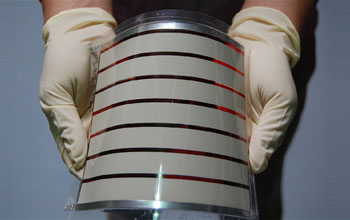 Credit: Solarmer Energy, Inc
Initially announced with 28 participating companies--all NSF Small Business Innovation Research (SBIR) grantees--Eureka Park now has registered 94 start-up companies from around the world. Each will have its own booth in the Bellini Ballroom of theVenetian Hotel at CES, which runs from January 10-13.
"We are immensely proud of what Eureka Park has already become, a specialized exhibit area customized for start-ups to launch new products, services and even ideas," said Karen Chupka, senior vice president of events and conferences for CEA.
"The NSF has been instrumental in making Eureka Park the premier destination for budding entrepreneurs, fledgling start-ups and homegrown innovation," she said.
Initially announced with 28 participating companies--all NSF Small Business Innovation Research (SBIR) grantees--Eureka Park now has registered 94 start-up companies from around the world. Each will have its own booth in the Bellini Ballroom of theVenetian Hotel at CES, which runs from January 10-13.
"We are immensely proud of what Eureka Park has already become, a specialized exhibit area customized for start-ups to launch new products, services and even ideas," said Karen Chupka, senior vice president of events and conferences for CEA.
"The NSF has been instrumental in making Eureka Park the premier destination for budding entrepreneurs, fledgling start-ups and homegrown innovation," she said.
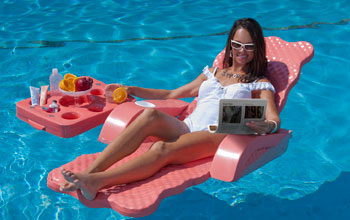
Gamma Dynamics has developed electrofluidic display technology for various electronic paper applications such as eBook readers. The key attributes of the displays are low power consumption, high brightness and optimal readability in both low and high ambient light settings; the technology also lends itself to full color and video. See a microscale demonstration of the display technology in this video.
Credit: Texas Recreation Corporation (modified by Losantiville, a design collective, Losantivilleltd.com); Gamma Dynamics
A number of established companies--such as Google, Audysseyand Qualcomm, which will deliver a 2012 CES keynote--have foundations in NSF basic-research and small-business support, and such companies have had a long history at CES. However, this is the first time NSF-supported tech startups, with few or no products yet in the marketplace, will have a chance to show off their breakthroughs.
Years of NSF investment in basic research at universities spawned many of the NSF SBIR companies at Eureka Park. The researchers behind such discoveries recognized that their discoveries had commercial potential, but most lacked the business training to take their ideas to commercialization.
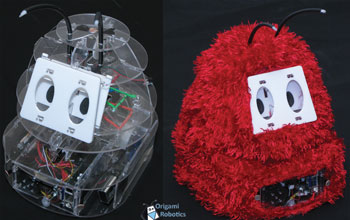
Romibo is a DIY assistive robot for social therapy, STEM education or just fun developed by the Quality of Life Technology Center NSF Engineering Research Center based at Carnegie Mellon University. Learn more on the Romibo website and watch a video of the center's technology.
Through NSF's SBIR program and related initiatives, such emerging entrepreneurs benefitted from both funding support and guidance.
One form of guidance includes follow-up assistance through an NSF-supported partnership with the Innovation Accelerator Initiative, which works to enhance commercialization and helped coordinate the SBIR participation at the 2012 CES.
Credit: Aubrey Shick and Garth Zeglin, Carnegie Mellon University, Quality of Life Technology Center
Through NSF's SBIR program and related initiatives, such emerging entrepreneurs benefitted from both funding support and guidance.
One form of guidance includes follow-up assistance through an NSF-supported partnership with the Innovation Accelerator Initiative, which works to enhance commercialization and helped coordinate the SBIR participation at the 2012 CES.
Barrett Technology's advanced robotic WAM (TM) (Whole Arm Manipulator) carefully grasps a bottle in a scene from a recent episode of NSF's Science Nation. At CES, Barrett will demonstrate the robot's hyper-dexterity, optimal kinematics, force sensitivity, and intuitive "teach-and-play" mode. Barrett will also be showcasing the capabilities of the BarrettHand, a multi-fingered programmable grasper.
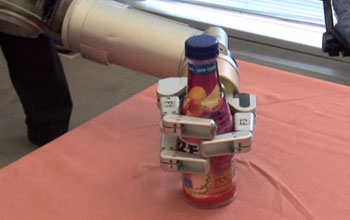 Credit: NSF Science Nation; Barrett Technology
"For decades, NSF has supported the creation of useful technologies, products and processes from science and engineering discoveries," said Murali Nair, NSF program officer for small business grants. "We push our small business grantees to take advantage of opportunities, like those provided by Innovation Accelerator and CES, to market their high-technology products, grow their business and become viable, profitable companies."
One NSF-supported exhibitor outside of Eureka Park, yet also bridging the university and commercial worlds, is the Quality of Life Technology Center, an NSF Engineering Research Center at Carnegie Mellon University. The center supports people with disabilities and the elderly through the development of technologies that include Vibe Attire--a clothing enhancement that turns music into tactile vibrations--and PerMMA 1.0--a powered wheelchair with user-controlled robotic arms. Both technologies will be on display.
"For decades, NSF has supported the creation of useful technologies, products and processes from science and engineering discoveries," said Murali Nair, NSF program officer for small business grants. "We push our small business grantees to take advantage of opportunities, like those provided by Innovation Accelerator and CES, to market their high-technology products, grow their business and become viable, profitable companies."
One NSF-supported exhibitor outside of Eureka Park, yet also bridging the university and commercial worlds, is the Quality of Life Technology Center, an NSF Engineering Research Center at Carnegie Mellon University. The center supports people with disabilities and the elderly through the development of technologies that include Vibe Attire--a clothing enhancement that turns music into tactile vibrations--and PerMMA 1.0--a powered wheelchair with user-controlled robotic arms. Both technologies will be on display.
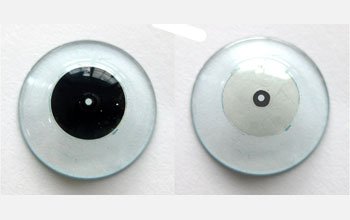
The polarized contact lens shown here was developed by Innovega to enable a wearer to see near-to-eye imagery simultaneously with the surrounding environment. The Innovega CES demonstration will use contact lenses mounted to a digital video system to emulate how images would look to a wearer.
 Credit: Randall Sprague, Innovega Inc.
"Through their QoLT Foundry, the Quality of Life Engineering Research Center has developed an exemplary review and vetting process to move their university-based research to commercialization," says Barbara Kenny, the NSF program director overseeing the center's grants. "We're pleased to see the QoLT ERC bring these engineering innovations, spin-off companies and translational research projects more directly into the public eye."
emota.TV is a SmartTV app for bringing the Emota experience into the living room. The system is designed for those who want to stay close with remote friends and family without having to learn computer and internet skills, or for those who just want to stay away from the computer when they are home.
 Credit: Emota.net, Inc.
Learn more about the 2012 CES at their website.
See videos of several of the technologies at:
MiserWare
Zienon
Quality of Life Technology Center
Medken
Gamma Dynamics
Barrett
"Through their QoLT Foundry, the Quality of Life Engineering Research Center has developed an exemplary review and vetting process to move their university-based research to commercialization," says Barbara Kenny, the NSF program director overseeing the center's grants. "We're pleased to see the QoLT ERC bring these engineering innovations, spin-off companies and translational research projects more directly into the public eye."
emota.TV is a SmartTV app for bringing the Emota experience into the living room. The system is designed for those who want to stay close with remote friends and family without having to learn computer and internet skills, or for those who just want to stay away from the computer when they are home.
Learn more about the 2012 CES at their website.
See videos of several of the technologies at:
MiserWare
Zienon
Quality of Life Technology Center
Medken
Gamma Dynamics
Barrett

0 comments:
Post a Comment